


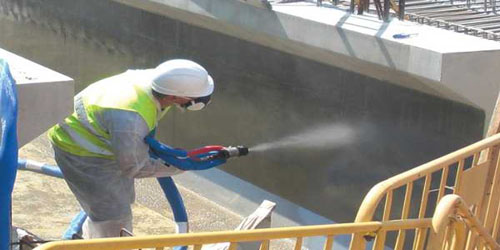
Protective surface coatings are primarily used to protect new or repaired concrete surfaces from future chemical attack (e.g. against sulphurous and nitrous pollutants) and the ingress of aggressive liquids and gases (e.g. waterborne chlorides or atmospheric carbon dioxide). This concrete surface
protection can also be specified to be: water-repelling through impregnation and pore blocking; elastic and crack-bridging (to different degrees of elasticity at different temperatures); resistant to different chemicals (such as in containment zones); or abrasion and wear resistant (e.g. on horizontal
concrete surfaces such as balconies and car park decks).
In order to meet all of the different requirements for concrete facades and horizontal concrete surfaces on different structures and in different exposure conditions, there are a wide range of different protective concrete coating products and systems required.
On reinforced concrete facades single pack, acrylic resin based anti carbonation coatings are normally ideal as the protective coating solution.
Also ideal are protective coatings based on, elastic film-forming, styrene acrylates or other copolymer resin based products, which should be used when additional crack-bridging properties are required. On horizontal decks for combined chemical and wear resistance, the best protective deck coating
products are usually 2 component epoxy and polyurethane resin based solutions that are specifically designed to accommodate this additional stress and exposure.
In the European Standard EN1504 Part 9 Principle 1 (Protection Against Ingress) Method 1.2 Surface Coating – With or Without Crack-Bridging Capability; Principle 2 (Moisture Control) Method 2.2 Surface Coating; Principle 5 (Physical Resistance), Method 5.1 Overlays or Coatings; Principle
6 (Chemical Resistance) Method 6.1 Overlays or Coatings; Principle 8 (Increasing Resistivity) Method 8.1 Increasing Resistivity by the Use of Surface Treatments or Coatings; and Principle 9 (Cathodic Control) Method 9.1 Limiting Oxygen Content (at the Cathode) by Saturation or Surface
Coating – All of these Principles and Methods can apply as appropriate for the individual reinforced concrete structure’s condition and requirements.
The characteristics and performance requirements for Protective Surface Coatings to be used on reinforced concrete are defined in the European Standard EN1504 Part 2, with the appropriate product selection then to be made in accordance with the specific requirements and exposure conditions
of your project.
Protective coatings: Early concrete erosion and erosion in structures and buildings is one of the problems long-standing users have been facing, and the lack of attention to this issue will surely bring many or irreparable financial losses, In addition to conventional methods for preventing penetration and corrosion of concrete and sealing it, use of natural and synthetic pozzolan cements, microcrystalline silica, cathodic protection, reinforcement coatings with epoxy resin, the use of protective sheets of alloys, alloys and composites reinforced, use Protective coatings and polymer concrete are one of the most cost effective and effective methods
Nowadays, to apply this degradation, the application of polymeric coatings on concrete surfaces can be the best option or offer. The bulk of cracking and cracking at the concrete level will be due to internal interactions and associated gases, surface evaporation and tensions at the surface, which will show itself as superficial cracks with empty spaces.
Concrete protective coatings are divided into two main groups: silicate coating and polymer coating

 Unit 9, bldg No 1107, majidiye street, Resalat highway, Tehran
 +9821 2632 1189
 info@arkatechnic.com