


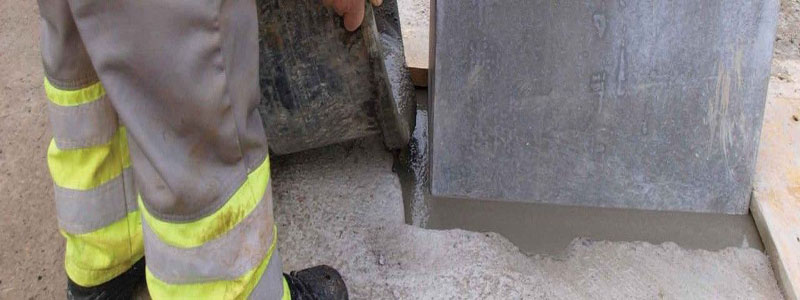
Grout is a particularly fluid form of concrete used to fill gaps. Grout is generally a mixture of water, cement, and sand, and is employed in pressure grouting, embedding rebar in masonry walls, connecting sections of pre-cast concrete, filling voids, and sealing joints such as those between tiles. Some common uses for grout in the household include: filling in tiles of shower floors and kitchen tiles. It is often color tinted when it will remain visible, and sometimes includes fine gravel when being used to fill large spaces (such as the cores of concrete blocks). Unlike other structural pastes such as plaster or joint compound, correctly mixed and applied grout forms a waterproof seal.
Although both grout and its close relative mortar are applied as a thick emulsion and harden over time, grout is distinguished by its high viscosity and lack of lime (added to mortar for pliability); grout is thin so it flows readily into gaps, while mortar is thick enough to support not only its own weight, but also that of masonry placed above it
The main difference between mortar and grout is the amount of water in the mix. Grout must be made with enough water to make it pourable or pumpable but not with so much water that the grout components segregate. Grout slump generally should be between 10 1/2 and 11 inches. Mortar, on the other hand, should contain only enough water to produce a smooth, plastic, “buttery” consistency that sticks to the trowel and is easy to spread. Mortar and grout also contain different ingredients. Mortar often contains hydrated lime; grout usually contains little if any hydrated lime (ASTM C 476, Specification for Grout for Masonry, allows up to 1/10 part lime to 1 part cement). In addition, coarse grout contains larger aggregates than mortar or fine grout. Mortar should not be substituted for grout unless the substitution is allowed by the architectural specifications. Mortar often is too stiff to flow around steel into small cavities or cores without leaving voids. These voids not only reduce strength but also can lead to water leakage problems. Mortar often is used to slush collar joints instead of filling collar joints with grout. This practice is convenient for masons but has disadvantages. First, slushing joints with mortar provides much lower strengths. ACI 530/ASCE 5/TMS 402 Building Code Requirements for Masonry Structures requires that allowable stresses be reduced by 50% when mortar is used instead of grout in collar joints. Second, the resulting voids often create channels that can carry rainwater from the outer wythe to the inner wythe. Concrete shouldn’t be substituted for grout either. The coarse aggregate in concrete generally is too large for most masonry grout cavities. Also, in cast-in-place concrete, low water-cement ratios are important for strength. For this reason, water-reducing admixtures often are added to concrete instead of more water to increase flow. This isn’t necessary nor desirable with grout for masonry. Because the water in grout is absorbed by brick or concrete block, the water-cement ratio of grout is greatly reduced as soon as the grout is poured into the wall. After grout that is made with a low water-cement ratio is poured into the masonry, it may not have enough water left for proper hydration and strength gain. Most problems with grout are related to too little water rather than too much water.

 Unit 9, bldg No 1107, majidiye street, Resalat highway, Tehran
 +9821 2632 1189
 info@arkatechnic.com